


Repression against so-called "illegal" churches: MINATD moves up a gear
Following the last governors' conference held from July 23 to 25, 2013 at the Palais des Congrès in Yaoundé and chaired by the Minister of Territorial Administration and Decentralization (MINATD), governors had been ordered to close down "illegal" religious associations.
In all likelihood, the order came from the Head of State, His Excellency Paul BIYA, who ordered the closure of nearly a hundred Christian churches, the main reason being the illegality with which they operate, to which can be added the "criminal practices" organized by Pentecostal pastors and threatening the nation's security.
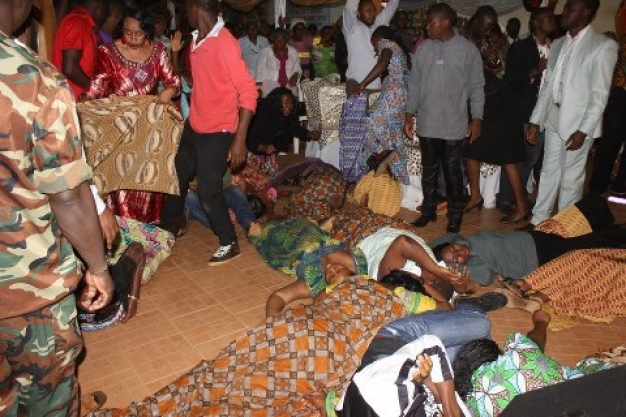
To this end, a government official told CNN, "We're going to get rid of all the so-called Pentecostal pastors who abuse the name of Jesus Christ for false miracles and kill citizens in their churches.They have extended their freedom".
Cameroon is said to have more than 500 churches of all denominations, compared with 47 duly authorized.
In the field, a good number of churches have been sealed, simply reflecting their precarious state of operation from the point of view of the law.
In Yaoundé, for example, prophet Dieunedort KAMDEM's "Cathédrale de la Foi" has been closed, while in Douala, the "Liberty Church International" has suffered the same fate, to name but a few.
From the end of July to the present day, some sources indicate that over sixty churches have been closed in all ten regions of Cameroon, and the action continues.
Camfaith's investigation focuses on the following questions:
- What are these churches accused of?
- What are the legal requirements for opening a religious association in Cameroon?
- What is the list of authorized religious denominations in Cameroon?
- From a biblical point of view, how do we assess these repressions?
1. Reproaches to revivalist churches in Cameroon
More than one Cameroonian citizen questioned on the subject cites the following points:
- Proliferation of churches (divergent names, transformed houses, bar rooms, cinemas etc.);
- Impostures of certain "pastors, prophets..." (swindling, interference in Christian affairs, financial pressure on members, sale of "holy waters", "anointing oils", etc.);
- Noise and night-time nuisance (nights of prayers over loudspeakers, nights of praise disturbing the whole neighborhood, etc.);
- Interference and disturbance in homes (hijacking of marriages, divisions between couples, etc.).);
- Diversion of minors (disruption of children's school life by religious activities, rebellion of children within their families...);
- False miracles (false healings, false deliverances orchestrated to sell the illusion, attract followers and make money...);
- Impoverishment of citizens (offerings for prayers, sales of religious services, financial support for the church...)...
Not to mention "servants of God" accused of immorality...
These reproaches are listed here in quick succession, but do not reflect Camfaith's point of view.
2. Provisions under Cameroonian law for a religious association
Cameroon recognizes and respects the right to freedom of association and freedom of worship, as recognized by MINATD.
Under Cameroonian law, only the President of the Republic is empowered to sign the decree authorizing the creation and opening of a religious association. The decree issued by the Head of State follows a dossier prepared by Minatd, containing the results of a morality investigation on the promoter and various other elements. The file is made up as follows
- A stamped application addressed to the Minister of Territorial Administration and Decentralization;
- Three copies of the association's articles of association;
- Three copies of the by-laws;
- Three copies of the minutes of the Constituent Assembly;
- Three copies of the list of members of the board of directors or executive committee, with a signed and legalized undertaking to respect the provisions of article 4 of law n°90/053 of December 19 on freedom of association.
The Ministry of Territorial Administration and Decentralization specifies that the statutes must be drawn up in accordance with the law on freedom of association.
The file thus constituted is deposited with the prefecture of the place where the association has its headquarters. The Prefect then forwards the file to its addressee (Minatd). Next, the Prefect conducts a morality and age check on the members of the Board of Directors.
The results of these investigations are forwarded to the Minister of Territorial Administration and Decentralization, who examines the file with a favorable opinion and submits it to the Office of the President of the Republic.
The President of the Republic alone gives authorization by decree, and the religious association is then able to operate.
3. List of authorized religious denominations in Cameroon to date
REGISTRATION NUMBER - NAME - HEADQUARTERS - AUTHORIZATION ACT
- Société Missionnaire Baptiste Européenne (Switzerland) - Zurich - Decision n°5851 of November 16, 1952
- Assemblée Chrétienne Témoins du Christ - Douala - Letter n°1319/INT/2 dated June 29, 1960
- Mission Catholique Romaine - Yaoundé - Decision n°16/ATF/APA/2 of February 20, 1962
- Presbyterian Church in Cameroon (P.C.C.) - Buéa - Letter n° 1 of April 14, 1962
- Eglise Presbytérienne Camerounaise (E.P.C.) - Yaoundé - Decision no. 55/ATF/2 of July 14, 1963
- Eglise Protestante Africaine du Cameroun (E.P.A.) - Lolodorf - Decision n°26/ATF/AT/2 of February 25, 1964
- Eglise Evangélique Luthérienne du Cameroun - Ngaoundéré - Decision n°63/ATF/AG2/2 of July 3, 1967
- Eglise Apostolique du Cameroun - Kumba - Decree n°68/DF/246/2 of July 10, 1968
- Eglise Fraternelle Luthérienne du Nord Cameroun - Kaéle - Decree n°69/DF/154 of April 26, 1969
- Full Gospel Mission - Muyuka - Decree n°69/DF/246 of April 26, 1969
- Eglise Frontières Globales - Kumba - Decree n°69/DF/4 18 of October 20, 1969
- Assemblée Spirituelle Nationale des Béhaistes - Limbe - Decree n°68/DF/436 of November 8, 1969
- Union des Eglises Evangéliques au Nord Cameroun - Mokolo - Decree n°70/DF/-5 of January 13, 1970
- Eglise Presbytérienne Camerounaise Orthodoxe (E.P.C.O.) - Yaoundé - Decree n°70/DF/88 of February 18, 1970
- Union des Eglises Baptistes du Cameroun (U.E..B.C.) - Douala - Decree n°71/DF/518 of October 20, 1971
- World Wide Mission - Muyuka - Decree n°71/DF/608 of December 3, 1971
- Eglise du Christ - Kumba - Decree n°71/DF/619 of December 14, 1971
- La Vraie Eglise de Dieu du Cameroun - Yaoundé - Decree n°71/DF/639 of December 31, 1971
- Eglise Baptiste Camerounaise (E.B.C.) - Douala - Decree n°72/DF/87 of February 16, 1972
- Congrégation Baptiste Camerounaise - Douala - Decree n°74/34 of January 19, 1974
- Eglise Evangélique du Cameroun - Douala - Decree n°74/DF/853 of October 14, 1974
- Islamic Cultural Association of Cameroon (A.C.I.C.) - Yaoundé - Decree n°88/319 of March 7, 1988
- Anglican Church - Douala - Decree n°89/143 of January 27, 1989
- Cameroon Baptist Convention (C.B.C) - Bamenda - Decree n°90/838 of May 4, 1990
- Mission de l'Eglise Evangélique Camerounaise - Douala - Decree n°91/159 of March 11, 1991
- Lutheran Church of Cameroon - Kumba - Decree n°91/257 of May 30, 1991
- Eglise Baptiste Nationale du Cameroun - Minyungu - Decree n°91/381 of August 16, 1991
- Eglise Biblique de la Vie Profonde - Yaoundé - Decree n°91/484 of December 3, 1991
- Association Solidaire de la Vocation Islamique du Cameroun ( A.S.S.O.V.I.C.) - Yaoundé - Decree n°92/032 of February 21, 1992
- Eglise Universelle de Dieu - Yaoundé - Decree n°92/l 72 of August 27, 1992
- Église Néo- Apostolique du Cameroun - Yaoundé - Decree n°92/225 of October 30, 1992
- Eglise Jean Baptiste du Cameroun - Sangmélima - Decree n°92/226 of October 30, 1992
- Islamic Union of Cameroon - Douala - Decree n°92/236 of November 13, 1992
- Jehovah's Witnesses of Cameroon - Yaoundé - Decree n°93/043 of February 3, 1993
- La Voie au Cameroun - Yaoundé - Decree n°93/144 of May 28, 1993
- Apostolic Faith Church - Bangem - Decree n°93/158 of June 9, 1993
- Eglise Messianique et Evangélique du Cameroun - Yaoundé - Decree n°93/l 71 of July 1, 1993
- The Church of Jésus-Christ of Late Days Saints - Yaoundé - Decree n°93/238 of September 9, 1993
- Mission Chrétienne du Cameroun - Nko'emvon - Decree n°93/287 of October 21, 1993
- Grâce Bible Church in Cameroon - Yaoundé - Decree n°94/220 of November 7, 1994
- Church of God of Prophecy - Kumba - Decree n°96/067 of April 4, 1996
- Native Church of the Cameroon - Ndom Bakossi - Decree n°98/047 of March 27, 1998
- Union des Eglises Adventistes du 7éme jour Afrique Centrale - Yaoundé - Decree n° 98/049 of March 27, 1998
- Union Baptiste Camerounaise - Douala - Decree n°98/050 of March 27, 1998
- Mission Evangélique Vie et Paix du Cameroun - Douala - Decree n°98/302 of November 18, 1998
- Eglise Pentecôtiste Chrétienne du Cameroun - Yaoundé - Decree n°98/359 of December 29, 1998.
- La Sainte Métropole Gréco-Orthodoxe du Cameroun - Yaoundé - Decree n° 070 of February 12, 2009
4. Biblical viewpoint
We do not wish to pass judgment here against the administration of our country, recognizing that it is the authority in charge of social order, especially as it does not oppose the creation of religious associations, but regulates them, which seems normal to us in this respect.
Some opinions take Jesus Christ as an example, saying that he needed no human authorization to preach, and that the Roman authorities would never have authorized him.
While we have nothing against the Cameroonian administration and even less against the proliferation of assemblies, we would like to list a few points to consider below:
- Jesus was concerned about his reputation in his environment ("What do people say about me?" Matthew 16:13);
- Jesus very often avoided scandalizing people ("So as not to scandalize them, go..." Matthew 17:27);
- Jesus recognized the right of the Roman administration ("Render to Caesar what is Caesar's. ...." Luke 20:25);
- Jesus' parents complied with the census orchestrated by the territorial administration of their day ( Luke 2:1-5);
- Jesus did not ask for money to pray for the needy, ("You have received freely, give freely.matthew 10:8);
- Jesus did not sell "holy water", "anointing oil"...
- Jesus received voluntary donations;
- Jesus performed miracles and very often asked to keep them secret, so no publicity was necessary;
- Jesus encouraged children to obey their parents without abdicating their responsibilities (Mark 10:7-13);
- Jesus was an itinerant preacher (which may explain why he didn't need authorization, since he hadn't created any associations);
- Jesus advised us to be prudent and simple (Matthew 10:16);
We also note that in the context of Cameroon, the Christian faith is marred by divisions between Christians, for example:
- As soon as a Christian thinks he knows the Word of God, he thinks he's starting a church;
- Many servants of God in Cameroon call themselves "Pastor, Prophet, Apostle, Doctor..." without any real training, and most of them are the promoters of their own ministry - there are as many servants of God as there are denominations. The first Christians had 12 apostles in the same ministry;
- In certain neighborhoods, within a 100-meter radius, there are sometimes 03 awakened Christian assemblies, often fighting each other in preaching and fighting for souls;
- Weak collaboration between pastors of different associations;
- The Word of God is no longer the only reference, but rather we refer to the dominant religious currents or those coming from other skies (cases of introduction of holy water, anointed handkerchiefs, etc.).);
- A strong desire for independence on the part of some, and for enrichment on the part of others...
On the other hand, without being able to explain why, we note that since 1998, no other Pentecostal church has seen the light of day, which leads us to ask the following questions:
- Does this mean that no Pentecostal church has requested authorization since 1998?
- Some sources say they have submitted files and never received a response for years.
These and many other questions are on everyone's mind.
However, to compensate for the lack of authorization, many associations resort to covering up with another authorized church. This is why the association's banner often bears two names: first, that of the authorized association, and second, the name of the association itself.
In conclusion, we believe that we must pray for our authorities so that we can lead a peaceful life in our country, but above all that we must comply with the regulations of our administration, especially as the overall objective is not only to clean up "illegal" churches, but to fight against the evils that undermine society as part of a vast campaign of social cleansing.
What we can deplore is that the Church, the Body of Christ in Cameroon, has not been able to put itself in order on its own, so that it is the "uncircumcised" who have to do it, which is a disgrace for the Body of Christ and proves once again how much we need unity and revival.
Camfaith editorial staff.
🔍 Quick search
Quick filters:
📅 Gospel Agenda
April 2026
May 2026
📋 Coming events:
Advertisement
Your advertisement here
300x250 px
Comments